

Transparency is key to the Good On You brand rating system and essential for meaningful and verifiable industry progress. That’s why Good On You only considers publicly available information. Here’s what you need to know to successfully provide evidence for your updates.
Brands should disclose on their own websites
We consider a brand’s website (including sustainability reports or other published PDFs linked from the website) as the primary source for disclosures, as consumers have a right to know this information as they are shopping. This information should be easily visible and accessible to consumers and other stakeholders when they land on your website.
In certain cases, a link to an external third party might be more relevant such as a brand's CDP score or other relevant standards and certifications with a public register (check the guidance below for specific information types).
Use specific and tangible language when disclosing
In general, your public disclosures should be specific and provide tangible actions and evidence. For example don’t say something like “our suppliers recycle offcuts where possible”, as it’s vague and imprecise. Rather, share specific facts such as “40% of offcuts were reused and 30% recycled”.
For small brands with limited resources, Good On You has assembled this guide with tips about improving your sustainability communications.
Adding and submitting evidence in Good Measures
When you answer a question, you'll see an option “+Add evidence”. Just click on it and enter the relevant URL and any comments you think would be helpful for Good On You’s analysts to know (for example, specifics as to where to find the relevant evidence such as the page number for a PDF).
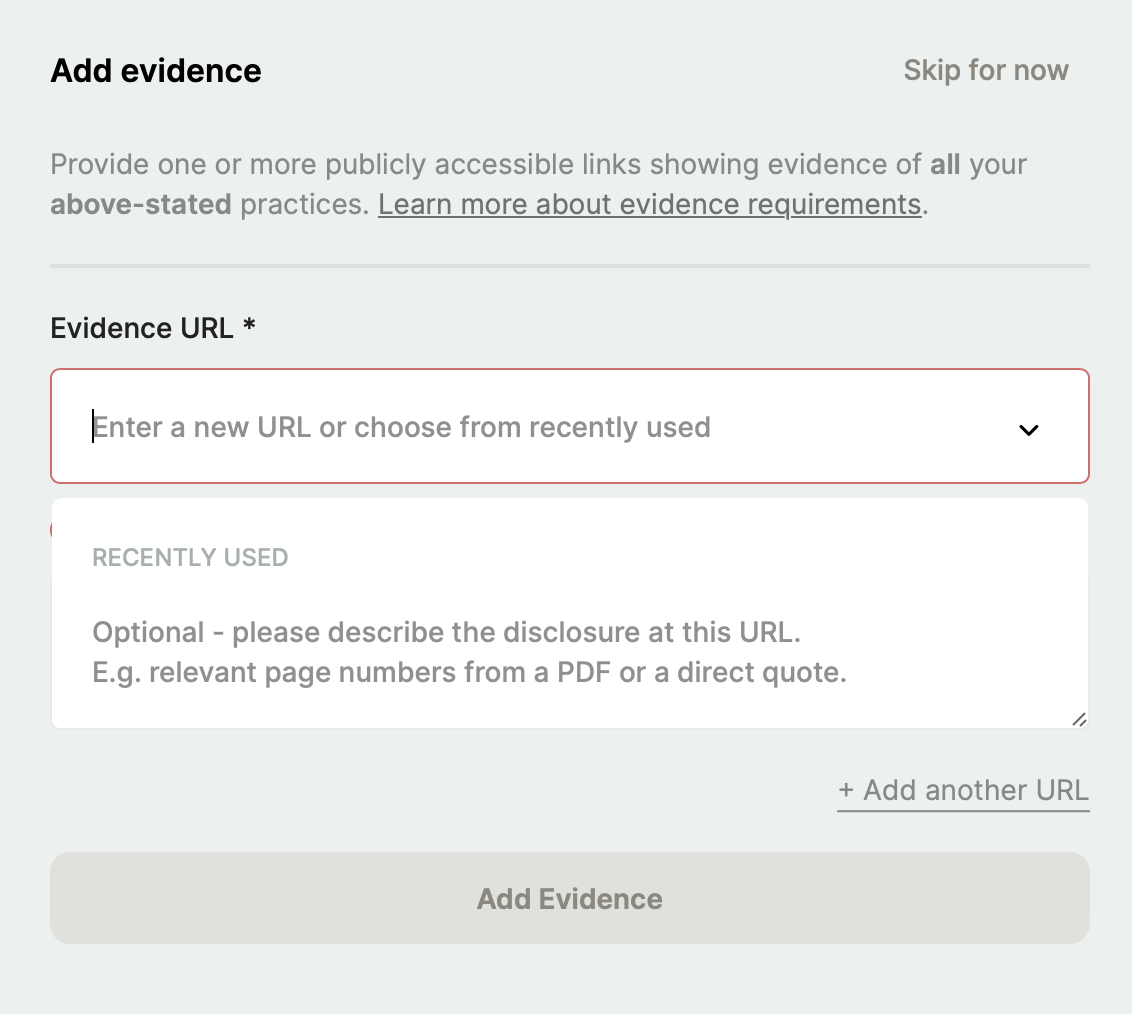
You should provide URLs to the most specific evidence that demonstrates your disclosure on the answers provided in each issue. Good On You’s ratings analysts will manually verify that the information available at the URLs you submit is suitable evidence. Learn more about why evidence is sometimes not accepted.
Review all issues before submitting your data for review.
Guidance on providing evidence for specific types of information
Standards and certifications:
You may provide a link to your own website where you disclose a certification. Ensure correct usage of the certification logo. You may provide a link to the external third party that publishes your certification or score for example for CDP. Learn more about how Good On You incorporates standards and certifications.
Product and material mix:
For some questions you will be asked to identify a proportion of products using certain materials, certified materials, or your total material mix. Ideally these proportions should be listed specifically on a sustainability report in which case you should indicate the relevant page number(s).
If you don’t have such a disclosure then provide a link to a single product or product range demonstrating usage of the material or certification. Good On You will validate the information provided in Good Measures against the proportion of products across the collection. If your product pages don’t disclose the relevant materials or product-level certifications then the information provided can’t be verified.
Targets and progress:
We will review evidence of targets disclosed on your website or in publicly accessible reports. Good On You will verify on external websites where relevant—for example, checking the Science-Based Targets initiative website to see that a target has been approved.
Wherever possible you should clearly report performance against previous targets on the brand website and/or in company reports. Learn more about how Good On You considers targets and progress made.
Evidence review
Once Good On You’s analysts have carefully reviewed your updated evidence, you’ll receive an email with the results of your rating review. This email will indicate what, if any, evidence wasn’t accepted.
There are several possible reasons why evidence isn’t accepted including:
Analysts couldn’t find the relevant information at the URL you provided;
Further searching yielded no other public information to support your update;
Or the information made publicly available insufficiently supported your update;
When this happens, the results email will notify you of the submitted updates that can’t be included in your score.
You’ll be able to review and resubmit your updates when you’re next eligible. Learn more about when you can submit again. The feedback email you receive after the rating review is complete will indicate issues where you may need to provide additional evidence to support an update—that way, you can take action to make more improvements the next time you submit.
Less commonly, your evidence might not have been accepted because there was a simple error (eg the page you linked to was temporarily unpublished). If you think this has happened, please contact us. You can message us directly when you’re logged into Good Measures—just tap the help bubble “💬” in the lower right corner. Or email us at goodmeasures@goodonyou.eco.